
3D Scanners
- Product
- Qty in Cart
- Quantity
- Price
- Subtotal
-
Out of stock

Creality RaptorX 3D Scanner
Creality
$5,579.00Free shipping in Canada for orders over $140 before tax. World's 1st Wireless Hybrid Blue Laser & NIR Scanner 34+7 Blue Laser Lines Portable Wireless Scanner Metrology-grade Accuracy up to 0...$5,579.00 -
Out of stockOn Sale
Creality Sermoon P1 3D Scanner
Creality
Now: $4,649.00Was: $4,899.00Free shipping in Canada for orders over $140 before tax. Creality Sermoon P1 All-in-One Professional 3D ScannerNow: $4,649.00Was: $4,899.00
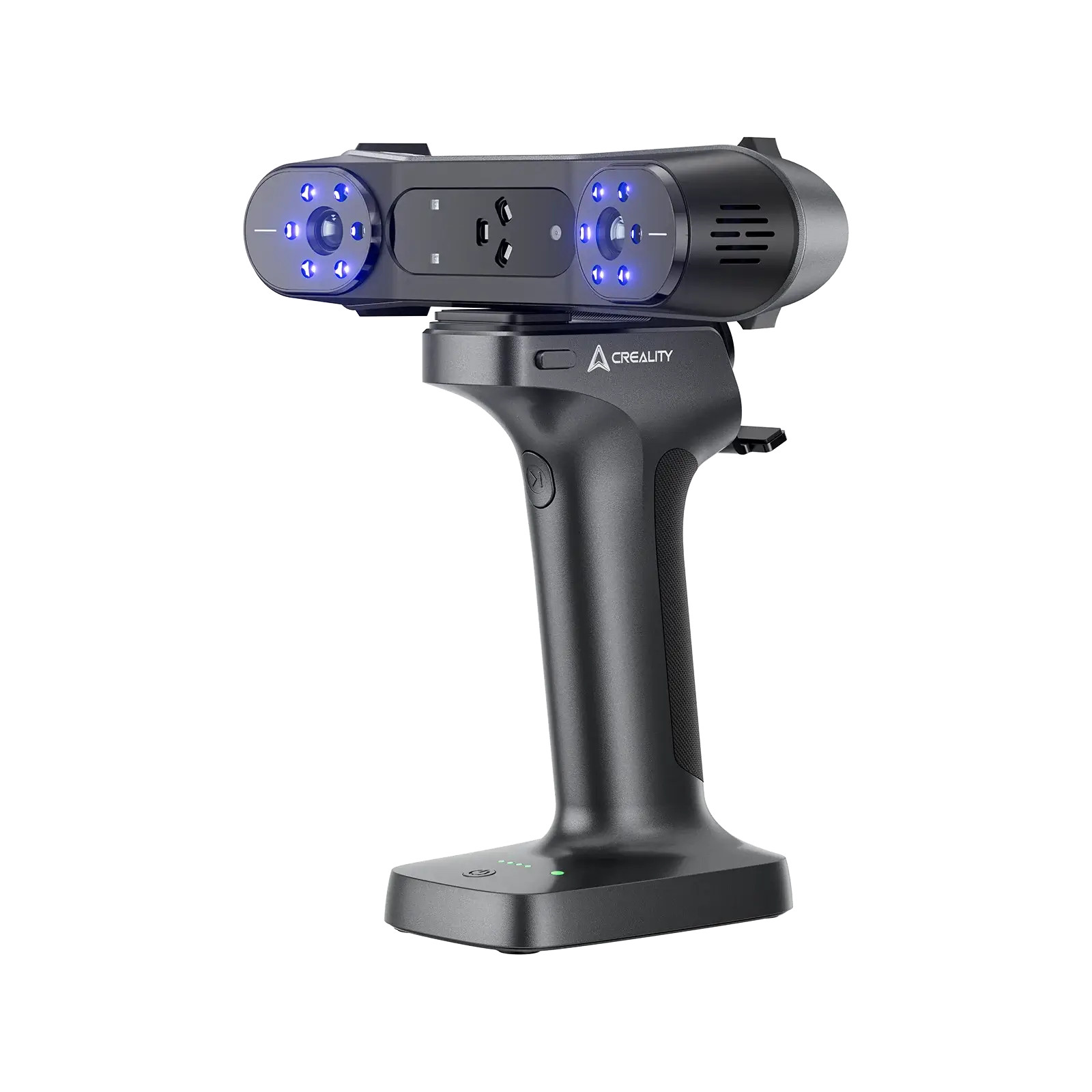
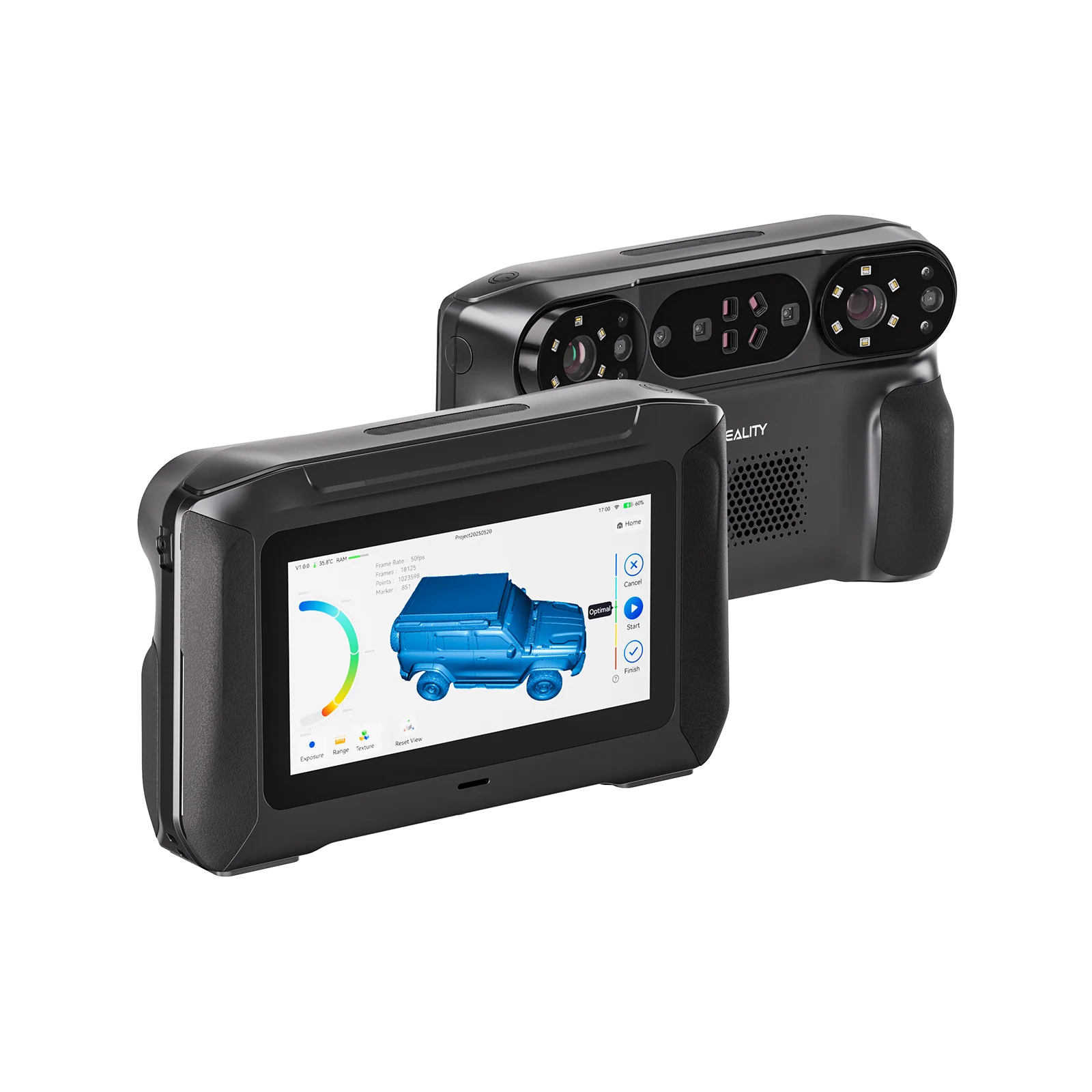
Creality Sermoon Pika vs. P1 vs. S1 vs. X1
- Pika: Best for creators, makers, education, art, personalized figures and portable full-colour scanning.
- Sermoon P1: Best for professionals who need an all-in-one scanner without carrying a computer.
- Sermoon S1: Best for users wanting a lightweight professional scanner for parts, vehicles and reverse engineering.
- Sermoon X1: Best for industrial inspection, photogrammetry and large components requiring the strongest dimensional accuracy.
Creality Pika vs. Sermoon P1, S1 and X1
| Specification | Creality Pika | Sermoon P1 | Sermoon S1 | Sermoon X1 |
|---|---|---|---|---|
| Product class | Portable AI creator scanner | All-in-one professional scanner | Professional handheld scanner | Industrial wireless scanner |
| Best suited for | Makers, art, figures, body scans and creative projects | Standalone field scanning and onboard processing | Portable professional reverse engineering | Industrial inspection and high-accuracy large-part scanning |
| Blue laser system | 7 parallel blue laser lines | 1 single, 7 parallel and 22 crossed lines | 1 single, 7 parallel and 34 crossed lines | 1 single, 7 parallel and 34 crossed lines |
| Infrared system | Binocular NIR structured light | Close- and long-range NIR structured light | Close- and long-range NIR structured light | Binocular NIR structured light |
| Maximum laser accuracy | Up to 0.03mm | Up to 0.02mm | Up to 0.02mm | Up to 0.02mm |
| Maximum NIR accuracy | Up to 0.03mm | Up to 0.075mm | Up to 0.075mm | Up to 0.05mm |
| Laser volumetric accuracy | 0.04mm + 0.1mm/m | 0.02mm + 0.06mm/m | 0.02mm + 0.08mm/m | 0.02mm + 0.04mm/m |
| Enhanced volumetric accuracy | Not specified | Not specified | Not specified | 0.02mm + 0.03mm/m with scale bars |
| NIR volumetric accuracy | 0.04mm + 0.1mm/m | 0.075mm + 0.1mm/m | 0.075mm + 0.1mm/m | 0.05mm + 0.1mm/m |
| Laser resolution | 0.05–2mm | 0.05–2mm | 0.05–2mm | 0.05–2mm |
| NIR resolution | 0.1–2mm | 0.1–2mm | 0.1–2mm | 0.1–2mm |
| Photogrammetry | No dedicated mode listed | No dedicated mode listed | No dedicated mode listed | Built in with two magnetic carbon-fibre scale bars |
| Deep-hole scanning | No single-line mode | Single blue laser line | Single blue laser line | Single blue laser line rated up to a 6:1 depth-to-diameter ratio |
| Minimum scan volume | 10 × 10 × 10mm | 5 × 5 × 5mm | 5 × 5 × 5mm | 5 × 5 × 5mm |
| Maximum laser scan size | 2000 × 2000 × 2000mm | 4000 × 4000 × 4000mm | 4000 × 4000 × 4000mm | 4000 × 4000 × 4000mm |
| Maximum NIR scan size | 2000 × 2000 × 2000mm | 2000 × 2000 × 2000mm | Approximately 2000 × 2000 × 2000mm | 2000 × 2000 × 2000mm |
| Maximum laser field of view | 290 × 240mm at 450mm | 380 × 365mm at 550mm | 506 × 433mm at 600mm | 650 × 531mm at 600mm |
| Maximum NIR field of view | 560 × 350mm at 500mm | 1450 × 1020mm at 1200mm | 1245 × 754mm at 1000mm | 1300 × 935mm at 1200mm |
| Maximum laser scan rate | 900,000 measurements/s | 1,740,000 points/s in wired mode | 1,428,000 measurements/s | 1,734,000 measurements/s |
| Maximum NIR scan rate | 3,500,000 measurements/s | 6,881,000 points/s in wired mode | 4,600,000 measurements/s | 5,000,000 measurements/s |
| Maximum laser speed | Up to 70 FPS on PC | Up to 100 FPS in wired PC mode | Up to 90 FPS | Up to 90 FPS |
| Maximum NIR speed | Up to 110 FPS on PC | Up to 30 FPS in wired PC mode | Up to 30 FPS | Up to 30 FPS |
| Standalone scanning | Limited onboard control and preview | Full standalone scanning and processing | No | No |
| Built-in display | 3-inch HD touchscreen | 6-inch Full HD touchscreen | No | No |
| Onboard model processing | Basic onboard interface; full processing through software | CPU, GPU, FPGA, 24GB RAM and 256GB storage | Requires a connected computer or accessory | Requires a connected computer |
| Wired PC mode | Yes | Yes | Yes | Yes |
| Wireless PC mode | Yes | Yes | Optional Scan Bridge | Included Scan Bridge |
| Wireless mobile mode | Yes | Not listed as a primary workflow | Available with optional wireless accessory | Mobile screen casting supported |
| Wireless technology | Built-in Wi-Fi | Wi-Fi 7 | Depends on accessory | Wi-Fi 6 AX6000 |
| Battery system | Two removable 3350mAh batteries | Two swappable 3300mAh batteries | Accessory-dependent | 5000mAh Scan Bridge battery |
| Advertised runtime | Extendable by swapping batteries | Extendable with the included second battery | Depends on accessory | More than four hours |
| Black and metal scanning without spray | Supported | Supported | Supported | Supported |
| Maximum laser outdoor light | Up to 110,000 lux | Up to 100,000 lux | Up to 100,000 lux | Up to 100,000 lux |
| Maximum NIR outdoor light | Up to 80,000 lux with filters | Up to 30,000 lux | Up to 30,000 lux | Up to 30,000 lux |
| Colour mapping | 24-bit colour supported | Supported | Supported | Supported |
| AI model tools | Body completion, hole filling and retexturing | Onboard mesh-processing tools | CrealityScan processing tools | CrealityScan processing tools |
| Gaussian Splatting | Supported | Not highlighted | Not highlighted | Not highlighted |
| Included turntable | Yes | Not listed | Not listed | Not listed |
| Included scale bars | No | No | No | Two magnetic carbon-fibre scale bars |
| Scanner weight | 260g | 830g | 508g | 530g |
| Scanner dimensions | 100 × 60 × 35mm | 209 × 129 × 53mm | 225 × 53 × 76mm | 216 × 74 × 51mm |
| Operating temperature | -10°C to 40°C | -10°C to 40°C | -10°C to 40°C | -10°C to 40°C |
| Windows and macOS support | Yes | Yes | Yes | Yes |
| Android and iOS support | Yes | Not listed as a primary workflow | Available with optional accessory | Mobile screen casting supported |
Scroll horizontally to view every model on smaller screens.
Best Creality 3D Scanner by Application
| Requirement | Recommended Model | Why |
|---|---|---|
| Most portable scanner | Creality Pika | Only 260g and compact enough to fit in a pocket or small bag. |
| Beginner-friendly creative scanning | Creality Pika | Touchscreen controls, an included turntable, AI repair tools and mobile support. |
| Figurines, art and personalized models | Creality Pika | Full-colour capture, AI retexturing and AI body-completion tools. |
| Fully standalone professional scanning | Sermoon P1 | Built-in processor, GPU, memory, storage, touchscreen and removable batteries. |
| Highest wired scanning performance | Sermoon P1 | Up to 100 FPS blue laser scanning and the highest stated wired NIR scan rate. |
| Lightweight professional reverse engineering | Sermoon S1 | Professional 1 + 7 + 34 blue laser system in a 508g handheld scanner. |
| Industrial inspection | Sermoon X1 | Rigid CNC-machined optical structure, wireless Scan Bridge and scale-bar photogrammetry. |
| Highest dimensional accuracy across large objects | Sermoon X1 | Enhanced volumetric accuracy of 0.02mm + 0.03mm/m with the included scale bars. |
| Deep holes and recessed areas | Sermoon X1 | Single-line blue laser mode rated for holes with up to a 6:1 depth-to-diameter ratio. |
| Outdoor creative scanning | Creality Pika | Rated up to 110,000 lux in laser mode and up to 80,000 lux in filtered NIR mode. |
| Human-body and full-colour scanning | Creality Pika or Sermoon P1 | Pika emphasizes portable full-colour and AI-assisted workflows, while P1 provides a much larger NIR field of view and full standalone processing. |
Scanning Scenarios:
The MINI series is designed for professionals who want to scan smaller objects such as industrial parts, jewelry, small statues, etc., capturing precise detail.
The POP series is designed for professionals who want to scan medium-sized objects, such as engine parts or vases.
The RANGE series is designed for professionals who want to scan large objects such as furniture, people, and vehicles, ensuring efficient and thorough scanning results.
The INSPIRE is for hobbyists, 3D printing enthusiasts, and makers who want to scan medium-sized objects.
The MIRACO is an all-in-one scanning system that captures small to large objects.
| Revopoint 3D Scanner | Inspire | MINI 2 | POP 3 Plus | RANGE 2 | MIRACO | MIRACO PLUS | MetroX |
| $, Starting at | $649 | $1229 | $765 | $1079 | $1929 | $2670 | $1549 |
| Single Frame Accuracy, up to | 0.3mm | 0.05mm | 0.08mm | 0.3mm | 0.05mm | 0.04mm | 0.03mm |
| Single Frame Precision, up to | 0.2mm | 0.02mm | 0.04mm | 0.1mm | 0.02mm | 0.02mm | 0.01mm |
| Min Scan Volume | 50x50x50mm | 10x10x10mm | 20x20x20mm | 50x50x50mm | 10x10x10mm | 10x10x10mm | 10x10x10mm |
| Max Scan Volume | 1x1x1m | 500x500x500mm | 2x2x2m | 4x4x4m | 4x4x4m | 4x4x4m | 1x1x1m |
| Working Distance | 250-500mm | 120-250mm | 150-400mm | 400-1300mm | 100-1000mm | 100-1000mm | 200-400mm |
| Scanning Speed, up to | 18fps | 16fps | 18fps | 16fps | 15fps | 20fps |
Multi-line Blue Laser: 800,000 Points/s Full Field Blue Light: 7,000,000 Points/s |
| Scanning Environment |
Indoor Outdoor |
Indoor |
Indoor Outdoor |
Indoor Outdoor |
Indoor Outdoor |
Indoor Outdoor |
Indoor |
| Scanner Weight | 140g | 175g | 190g | 253g | 750g | 750g | |
| Tech |
Dual Camera Infrared Light |
Dual Camera Blue Light |
Dual Camera Infrared Light |
Dual Camera Infrared Light |
Quad Camera
Infrared Light |
Quad Camera Infrared Light Optical Zoom Ultra-resolution Photogrammetric Metrology |
Multi-line Laser Scan Full-field Structured Light Scan |
| Battery Capacity | n/a | n/a | n/a | n/a | 5000mAh | 5000mAh | n/a |
3D scanners are revolutionizing how we interact with the physical world. These innovative devices capture the shape and appearance of objects in three dimensions, transforming real-world objects into digital 3D models. This technology has applications across various industries, from manufacturing and healthcare to entertainment and art.
How 3D Scanners Work
3D scanners utilize various techniques to capture 3D data. Some common methods include:
- Structured Light: Projecting patterns of light onto an object and analyzing the distortions to determine its shape.
- Time-of-Flight: Measuring the time it takes for a laser pulse to travel to the object and back, determining distance.
- Photogrammetry: Capturing multiple images of an object from different angles and using software to reconstruct its 3D model.
Types of 3D Scanners
- Handheld Scanners: Portable and easy to use, ideal for scanning smaller objects.
- Desktop Scanners: Offer higher accuracy and resolution, suitable for scanning medium-sized objects.
- Industrial Scanners: Designed for high-precision scanning of large objects and complex surfaces.
Applications of 3D Scanning
- Manufacturing: Reverse engineering, quality control, rapid prototyping, and 3D printing.
- Healthcare: Creating custom prosthetics and implants, medical imaging, and surgical planning.
- Entertainment: Character modeling, special effects, and virtual reality.
- Art and Design: Creating digital sculptures, preserving historical artifacts, and customizing products.
- Archaeology: Documenting and preserving ancient artifacts.
Benefits of Using 3D Scanners
- Increased Efficiency: Streamline workflows and reduce production time.
- Improved Accuracy: Achieve precise measurements and capture intricate details.
- Reduced Costs: Minimize material waste and eliminate the need for physical prototypes.
- Enhanced Creativity: Unlock new possibilities for design and innovation.
The Future of 3D Scanning
3D scanning technology continues to evolve rapidly, with advancements in:
- Accuracy and Resolution: Capturing finer details with greater precision.
- Speed: Scanning objects faster and more efficiently.
- Portability: Developing smaller and more compact scanners.
- AI Integration: Utilizing AI for automated scanning and data processing.
3D scanners are powerful tools with a wide range of applications across various industries. As the technology continues to advance, we can expect to see even more innovative and exciting uses for 3D scanning in the future.