
Fiber Reinforced 3D Printer Filament
Shop reinforced filament by base material
Choose the base plastic first, then the reinforcement. Explore 1.75mm carbon fiber and glass fiber filament for your next prototype, fixture or finished part.
Nylon Composites
Compare PA6 and PA12, with carbon or glass reinforcement.
Polycarbonate Carbon Fiber
A PC composite for printers equipped for engineering materials.
CF = carbon fiber. GF = glass fiber. Use a wear-resistant nozzle and follow the selected product's printing requirements. Check each listing for sizes and availability.
- Product
- Qty in Cart
- Quantity
- Price
- Subtotal
-

1.75mm 3D Printer Cleaning Filament
SPOOL3D
$9.00Free shipping in Canada for orders over $140 before tax. (via Canada Post) Recommended for use between printing different filament types or after printing filled filament types. Easily clean up...$9.00 -
Out of stock
Nylon12 (PA12) - Carbon Fiber - 1.75mm 3D Printer Filament
SPOOL3D
$12.00 - $249.00Free shipping in Canada for orders over $140 before tax. (via Canada Post) We use Evonik Industries (Germany) industrial grade nylon 12. Print it right with Spool3D nylon 3D printer filament. Our...$12.00 - $249.00 -
RFID Tag For Automatic Filament Identification
SPOOL3D
$0.50 - $1.00Free shipping in Canada for qualifying orders over $140 before tax. The latest Creality firmware for your printer is required to use these tag$0.50 - $1.00

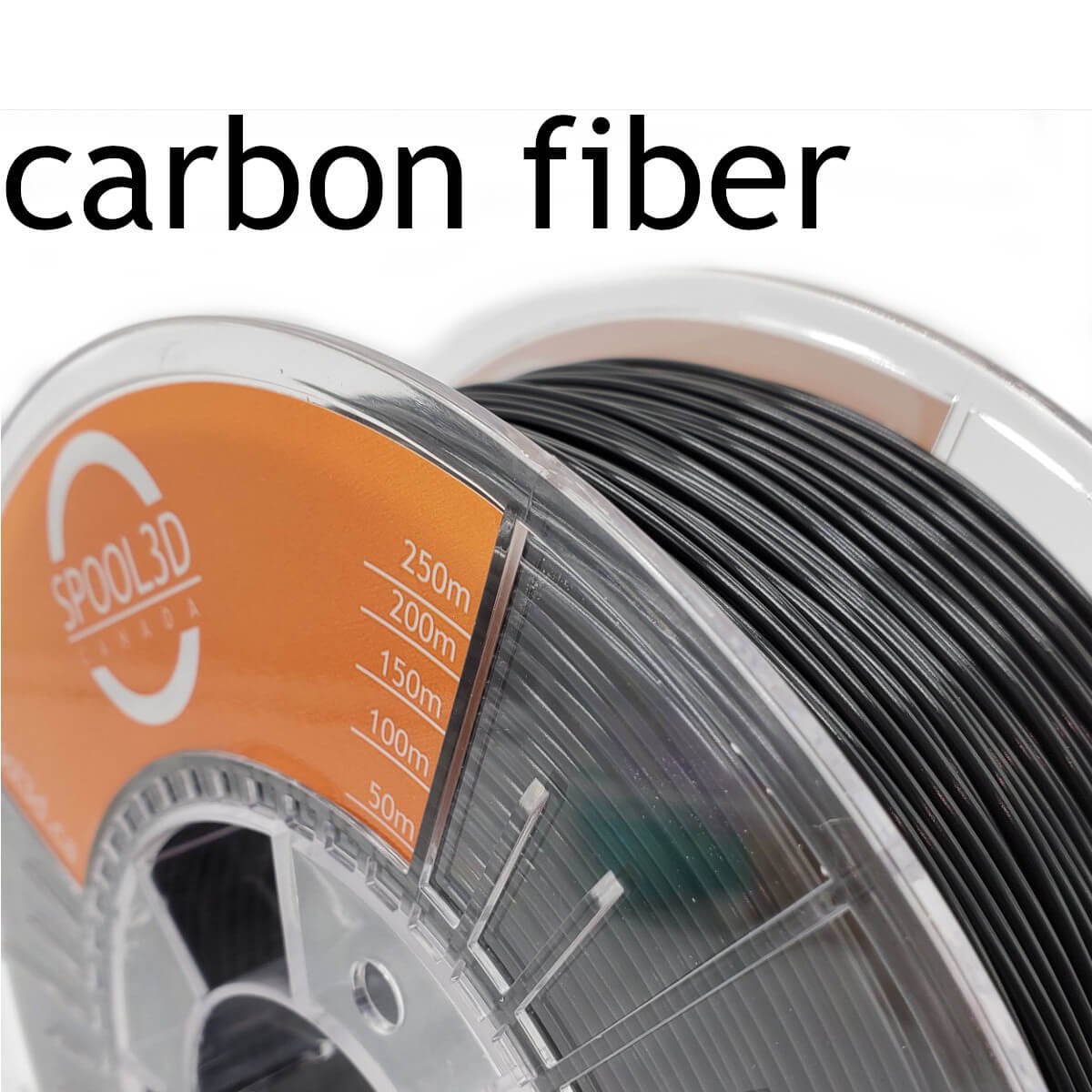

Choosing carbon fiber and glass fiber filament
Spool3D offers reinforced 1.75mm filament in Canada across PLA, PETG, ABS, ASA, nylon and polycarbonate. Start with the part's operating conditions and your printer's capabilities, then compare the individual grades. The base polymer remains an important part of that decision.
| Base material and grades | Consider for | Main purchasing check |
|---|---|---|
| PLA-CF | Rigid prototypes and matte display pieces | Check the grade's temperature limits for the finished part. |
| PETG-CF | Functional brackets and housings | Compare heat and impact requirements with the product's technical data. |
| ABS-CF and ABS-GF | Indoor functional parts and workshop projects | Plan for bed adhesion and enclosure requirements. |
| ASA-CF | Outdoor projects where weather resistance matters | Check enclosure requirements, especially for larger parts. |
| PA6-CF, PA6-GF and PA12-CF | Comparing reinforced nylon grades for mechanical projects | Include drying and dry storage in your printing setup. |
| PC-CF | Engineering projects with higher heat requirements | Confirm hotend, bed and enclosure capability for the exact grade. |
These are starting points for material selection. Check the product's technical data and test the printed part under its intended conditions.
Carbon fiber or glass fiber?
Both add fibers to a base thermoplastic, but the fiber name alone cannot tell you which finished print will perform better. Compare the actual formulations, including stiffness, impact performance, heat behaviour and print requirements. ABS and PA6 offer both carbon fiber and glass fiber choices in this range. Our nylon filament guide also compares PA6, PA12 and unfilled nylon options.
Reinforcement can improve stiffness and dimensional stability, but it does not guarantee better performance in every direction. Impact resistance or layer bonding may be lower than in an unfilled material. Match the grade and print orientation to how the part will be loaded.
What nozzle and printer do I need?
Carbon and glass fibers are abrasive. Choose a wear-resistant nozzle that fits your hotend, and follow the selected filament's minimum nozzle diameter. A nozzle upgrade alone does not establish compatibility: also check the printer's temperature limits, bed surface and enclosure guidance.
ABS, ASA, nylon and PC composites may need an enclosure to manage cooling and warping. Use settings for the exact product; a PLA-CF profile is not a starting profile for PC-CF. For automatic feeding, confirm the exact filament and spool against the requirements of your feeder model.
Do reinforced filaments need drying?
Fiber filling does not remove moisture-management requirements. Store filament sealed with desiccant, and follow the grade's drying instructions when needed. Nylon deserves particular attention before and during printing. Check that both the spool and dryer support the recommended drying temperature.
Choose a spool and order in Canada
Open a product to select its offered size and check current availability. Need help narrowing the choice? Contact Spool3D with your printer, nozzle, intended use and operating temperature. We offer Canadian shipping and Calgary pickup; see our shipping information or browse all filament materials.